The History of the Blueprint: From Cyanotype to BIM
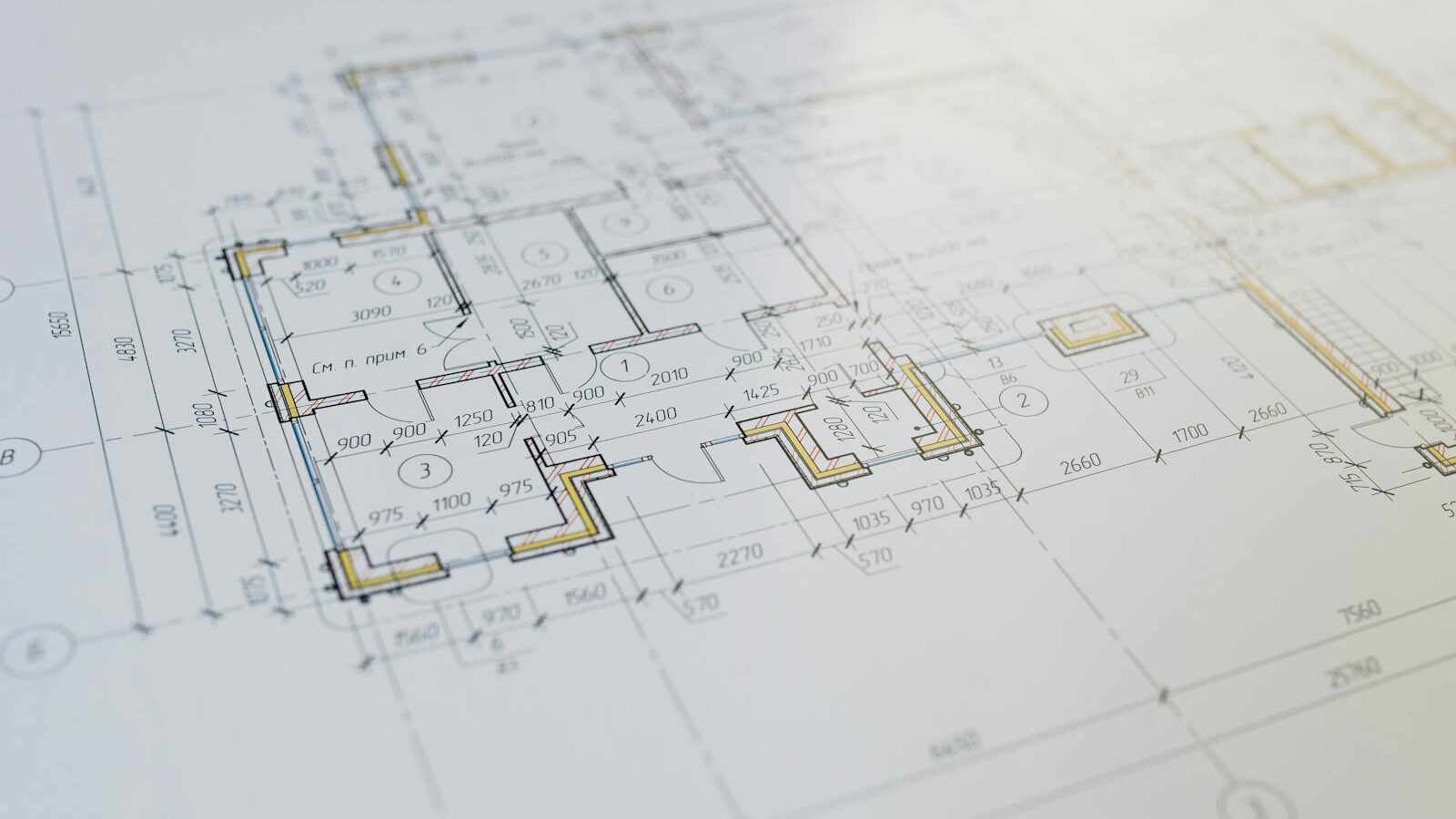
The word “blueprint” is so embedded in our language that we use it as a metaphor for any detailed plan — “a blueprint for success,” “a blueprint for reform.” Yet the literal blueprint — white lines on a blue background — has been largely obsolete as a construction document for twenty years. What replaced it, and how did architectural drawing technology evolve from a 19th-century photographic process to today’s parametric building information models? The answer illuminates not just a technical evolution, but a transformation in how architects conceive, communicate, and construct buildings.
The Cyanotype Process (1842 – 1950s)
The original “blueprint” was a cyanotype — a photographic reproduction process invented by the astronomer John Herschel in 1842. In architecture, the process worked as follows: a drafter would create an original drawing in ink on translucent tracing cloth or paper. That original was then placed over a sheet of paper coated with iron-ammonium citrate and potassium ferricyanide and exposed to ultraviolet light (initially sunlight, later UV lamps). Where light passed through the clear areas of the original, a chemical reaction turned the coating deep Prussian blue. Where the opaque ink lines blocked the light, the coating washed off in water, leaving bright white lines.
The result was a faithful reproduction of the original drawing — white lines on a vivid blue background — that could be produced in quantity, was relatively stable, and cost far less than redrawing the original by hand. The color scheme became so associated with construction drawings that “blueprint” entered the language as a synonym for the drawings themselves, regardless of their reproduction method.
Diazo Printing and the Blue-Line Era (1940s – 1990s)
The diazo (or whiteprint) process gradually replaced cyanotype from the 1940s onward. Diazo prints reversed the color scheme: blue or black lines on a white background, much easier to read and annotate. The process used light-sensitive diazonium salts that were exposed through a translucent original and developed with ammonia fumes. The machines that produced these prints — ammonia diazo printers — were fixtures in every architecture office for decades, distinguished by their characteristic ammonia smell.
Diazo printing was fast, cheap, and relatively faithful to the original. It became the dominant reproduction technology for construction drawings through the 1980s and remained common through the 1990s, even as CAD began to displace hand drafting as the original drawing medium.
Computer-Aided Drafting (1970s – 2000s)
Computer-aided drafting arrived in architecture in the late 1970s, initially on expensive workstations accessible only to large firms. AutoCAD, released in 1982, democratized the technology and by the late 1980s had begun transforming how architects produced drawings. CAD replaced the physical drafting tools — parallel bars, triangles, technical pens, and lead holders — with a software environment that allowed lines to be drawn, copied, moved, and scaled infinitely with precision that hand drafting could approximate but never guarantee.
The most important change CAD introduced was not speed (early CAD was not necessarily faster than skilled hand drafting) but reproducibility and revisability. On paper, a wall that needed to move required erasing and redrawing — an imprecise operation that could compromise the quality of the sheet. In CAD, moving a wall meant selecting it and repositioning it; all associated dimensions, hatch patterns, and adjacent elements could be updated rapidly.
Building Information Modeling (2000s – Present)
BIM — Building Information Modeling — represents a more fundamental departure from CAD than CAD represented from hand drafting. In CAD, the architect draws lines that represent architectural elements. In BIM, the architect places architectural objects — walls, doors, windows, structural members, MEP components — that contain intelligence about their properties, relationships, and behaviors.
A BIM wall knows it is a wall: it has a height, a thickness, a material assembly, a fire rating, a cost. When it intersects another wall, the junction resolves automatically. When a door is placed in it, the wall updates its geometry to accommodate the opening. When the building is “cut” at different elevations, the floor plan, sections, and elevations all generate automatically from the same underlying model — and when the model changes, all views update simultaneously.
The construction documents that emerge from a BIM process are still drawings — plans, elevations, sections, details — but they are generated rather than drawn. The architect’s intellectual work shifts from drafting toward modeling, coordination, and specification. And the model itself carries information — quantities, schedules, specifications — that can flow directly into cost estimation, energy analysis, structural analysis, and construction management without re-entry.
Interactive and Browser-Based Tools
The most recent chapter in this evolution is the emergence of accessible, browser-based design tools that bring floor planning capability to non-professionals. While BIM remains the domain of trained architects using specialized software, tools like our own Floor Plan Builder allow anyone to experiment with room layouts, understand spatial relationships, and develop a design vocabulary — before engaging a professional or simply to satisfy their own curiosity about how their home could be arranged differently.
The democratization of design tools mirrors the democratization of design information more broadly. The profession of architecture has always required specialization; the knowledge base it draws from need not remain proprietary. Understanding how space works — how rooms relate, how dimensions affect experience, how orientation shapes comfort — is knowledge that benefits everyone who inhabits buildings, which is everyone.
Have a Project in Mind?
Our licensed architects are ready to help. Free initial consultation.